
I know, I know. Just what you need: another recipe for steamed salmon.
There’s little original to say about this most popular of fish, save that I’m not fond of it. Well, that’s not exactly true. I’m happy to consume salmon smoked, generously draped atop a plain bagel with cream cheese.
Mr. IK feels quite differently about fish. He loves it all. This means I often find myself preparing fish dishes I have no intention of eating. Like this one.

—
Let us discuss fish bones. They make people nervous: nobody wants to choke on their food. I live with somebody who has trouble swallowing. Also coughing. Killing him with salmon bones is not on my summer to-do list. Let this reassure you.

You will be able to both see and feel the largest bones in your salmon fillet. Called pinbones, they run down the middle of the fish, and pull out pretty easily with clean fingers, needlenose pliers, or tweezers. Any remaining bones are easily removed once the fish is fully cooked.

Yes, these are weirdly huge tweezers.
Having deboned the salmon to the best of your ability–remembering we are not sushi chefs–season the salmon and set up your steamer.

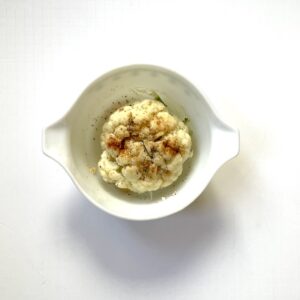
I realize few home cooks own steamers. Even fewer own fish poachers. Yes, some of us have stacking basket steamers, but they aren’t ideal here, as they tend to absorb odors. Lacking an illustrative photo, I give you more seasonings.

Fortunately, steamers are easily improvised. Large woks, deep, wide saucepans, and roasters all make good poaching vessels.

Into these we can fit racks: trivets, cake racks, wok racks, or heatproof cups. Lacking these, you can ball up tinfoil.
Atop the rack rests your (heatproof!) platter or bowl of salmon, adorned with lemon and herbs. Below, a large wok filled with water, a wok rack, and a clear glass pie dish.

In a perfect world your steamer has a lid. In an imperfect world, there is always tinfoil.

Steamed salmon is the work of moments. By the time the water boils, the fish is done.

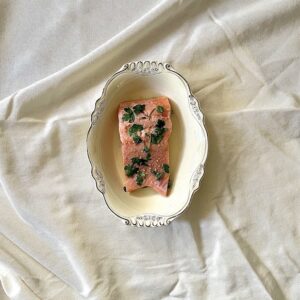
Steamed salmon pairs with numerous dishes including rice, couscous, freekeh, green salad, fresh peas, spinach, artichokes, or orzo. I could go on, but you get the idea.
Steamed Salmon with Lemon and Herbs
Prep time: about 20 minutes
Serving size: this recipe serves 1. See notes, below, for serving 3-4.
Please read the notes, below, for discussion of cooking methods, seasonings, and information concerning sustainable fish consumption.
1 center cut wild salmon fillet, weighing approximately 1/2-1 pound/225-500 grams
2 scant tablespoons mixed fresh herbs: parsley, chives, basil, lightly chopped or hand torn
1 teaspoon salt
1 teaspoon pepper
1 lemon, quartered
about 2 teaspoons sweet butter
1/4 cup/60 ml dry white wine, Vermouth, or dry apple cider
Set up a steamer:
You will need a heatproof bowl or deep platter that can hold the fish flat. I used a 9-inch/22-cm pasta bowl. Large woks, deep, wide saucepans, and roasters make good poaching vessels. You’ll need a rack: trivets, cake racks, wok racks (see above photo), or heatproof cups all work. Lacking these, you can roll tinfoil into balls and rest the bowl on that. Your steamer also needs a lid. Lacking one, you can use tinfoil.
Prepare the fish:
Place the fish in its bowl or platter.
Run your fingers down the center of the fillet. You will feel the pinbones. Pull them free using your very clean fingers, needlenose pliers, or tweezers. You probably won’t be able to completely debone the fish. Just do the best you can.
Season fish with salt and pepper. Squeeze a quarter of fresh lemon over the fish, tossing the exhausted quarter into the bowl if desired (or into the compost if not). Dot butter here and there in the bowl.
Scatter herbs around the fish.
Add the wine, pouring it down the side of the bowl. This will set some of the herbs afloat. That’s fine.
Set bowl atop steamer rack. Pour water into the steamer until it just reaches the top the of the rack. Don’t let the water reach bottom the bowl.
Toss a couple coins into the pot, add the lid, and turn heat to high.
When water reaches full boil, the change will rattle briskly.
Check fish for doneness: turn heat down. Wearing oven mitts, carefully lift steamer lid away from your face.
Check the salmon interior with a knife: it should still be a bit raw at the center, but not sushi raw. The fish will continue cooking off heat, so it should be close to done. If so, turn off heat and-again-carefully move bowl to a heat-proof surface. If not, cover steamer, turn heat to high, and allow salmon a scant couple minutes more before turning heat off.
Steamed salmon with lemon and herbs may be served from its steamer bowl, or moved to another dish. Either way, you may wish to add fresh herbs and the remaining lemon quarters.
Salmon partners well with numerous foods including rice, couscous, green salad, freekeh, peas, spinach, stir-fried greens, and orzo.
Leftovers may be refrigerated in a covered container up to three days or frozen up to three months.
Notes:
No fresh herbs? dried are okay, but use less.
The use of coins in the steamer comes from Carolyn Phillips, who shares it in All Under Heaven.
For three additional servings of salmon, add another 1/4 cup wine. Increase salt and pepper by a quarter teaspoon. I wouldn’t add more herbs lest they overtake the dish. The dish doesn’t need additional butter. To steam four pieces of fish, you can either cook in relays or set up one large steamer. Cooking time should not be impacted; again, check for doneness once water reaches full boil.
For timely information regarding ecologically sound fish purchases, see the Monterey Bay Aquarium’s Sustainable Seafood Guide.
Salmon may be oven roasted: Preheat oven to 325F/160C. Place salmon, skin side down, in baking dish with all ingredients. Cook 3-8 minutes, checking for doneness at 4 minutes. Fish is done when coral colored and slightly raw inside: it will continue cooking off heat.
Salmon can also be sauteed: cook in lidded saucepan, covered, over medium heat, skin side down. Total cooking time depends on size of fish, but expect 3-8 minutes. Fish is done when slightly raw within; it will continue cooking off heat.
Finally, I highly recommend Mark Bittman’s Fish to anyone wanting to become a better fish cook.