

Stir-Fried Okra
Today’s recipe, a simple stir-fry, came about after consulting numerous cookbooks. Few American cookbooks mention okra, and those who do often have little good to say about it. Deborah Madison, writing in Vegetarian Cooking for Everyone, can only manage “okra is slimy, and rather than try to ignore this fact, perhaps it’s just best to admit that’s how things are.” (In fairness, at least she says something. Other books just skip okra entirely.)

Okra’s slimy quality–also referred to as goo, but more accurately called mucilage–is useful for thickening stews like gumbo. Beyond that, one tends to find advice for ridding the vegetable, and thus the recipe, of offending goo. Cooks are instructed to search out the smallest specimens, to soak the pods in vinegar, to pare the tops carefully.

Mediterranean and Asian cooks treat okra quite differently. That is, they don’t care about okra’s inherent goo; it is simply another vegetable, and as such, receives no special attention. Which is what we want here.
So, on with it.
This was my maiden outing using mustard oil. I was expecting something much hotter, of the open the windows and use the oven fan variety. This was nothing of the sort.

Mustard oil is labeled “for external use” in the United States because it contains erucic acid. Scientific studies done in the 1950’s linked erucic acid to possible heart disease, but these studies were not conclusive. Nor is there an epidemic of mustard oil users developing cardiac ailments.

For an excellent and informative article by Nik Sharma about using mustard oil, click here.
If you decide mustard oil is not for you, canola or peanut oil make fine substitutes.

A word about using turmeric. Whether you opt for powder or root, turmeric loves nothing better than leaving distinctive yellow stains. Consider this when selecting cookware, dishtowels, and your favorite apron.

Whatever oil you decide to use, be mindful of the heat level. This is not a stir-fry in the Chinese sense of high speed, high heat cooking. Rather, it’s cooking the okra at medium heat, taking care not to burn the aromatics. If you have a wok or a karhi, great. If not, a wide heavy skillet will do.

Lacking a photo of my wok, here is the lid from the peppermill. Upside down.
Stir-fried okra is wonderful with rice or plain noodles. It is also delicious alongside plain poultry, white fish, or shrimp. At this time of year, a salad of sliced cucumber is a welcome accompaniment.

Stir-fried Okra
serves: 1-3, depending on what else is served
This recipe owes a great deal to Naomi Duguid’s Burma: Rivers of Flavor and Seductions of Rice, co-written with Jeffrey Alford.
10 ounces/280 grams okra
1 lobe shallot, peeled and sliced thinly
1 garlic clove, peeled and minced
2-3 tablespoons mustard, canola, or peanut oil (you may need a bit more)
1/2 teaspoon turmeric
1 teaspoon salt
1 teaspoon white pepper (black is fine if that’s what you have)
Optional:
1 dried red pepper or
1/8th -1/2 teaspoon cayenne, to taste
Rinse the okra.
Pare the stems and any skinny leaves attached; they’ll look like tiny fronds. Don’t cut all the way down; leave about 1/4 inch/1/2 cm attached. Trim the very ends, too.
Slice the okra into 1/2 inch/1 cm slices. Tossing these into a bowl will help keep your cutting board clean. I didn’t bother.
Peel the shallot and slice it thinly. Peel and chop the garlic.
Place a large wok, karhi, or large, heavy skillet on the stove over medium high heat. Add the oil.
Once the oil is warm, add the aromatics. Allow them to cook for 2-3 minutes, stirring. Do not let them burn.
Add the okra, turmeric, salt, and pepper. Add hot pepper/cayenne, if using, taking care not to touch your eyes, mouth, or other sensitive spots.
Stir-fry the okra, keeping the vegetables moving, adjusting the heat if anything begins burning. If you are using mustard oil and it’s intense (all brands differ), open a window. Turn on your oven fan, if you have one.
The okra takes about ten minutes to cook through. Taste-carefully, it’s hot!–for doneness and seasoning. Add oil if necessary, moving the pan off heat and pouring a little oil down the side of the pan.
Serve okra with rice, noodles, or alongside poultry, white fish, or shrimp.
Okra will keep in a refrigerated container up to four days. Freezing is possible, but not recommended.
Notes:
This recipe is infinitely flexible. Add fresh minced ginger to the aromatics. Use scallions instead of shallots. Add vegetables like summer squash, green beans, or tomatoes to the okra.
A final note about cleaning up. Your knife and cutting board are bound to be sticky. Lemon juice or white vinegar cuts will cut through this easily.

Share:
You might also like:
Okra Pilau
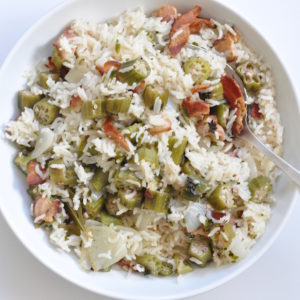
Thursday evening the doorbell rang. Our visitors were two boys who live in the apartment building next door. Their basketball had sailed over the fence dividing our properties, landing in our yard. This is not an infrequent occurrence. These are nice kids–well-behaved and remarkably polite. I retrieved the ball, then led the…
Vietnamese Beef Salad
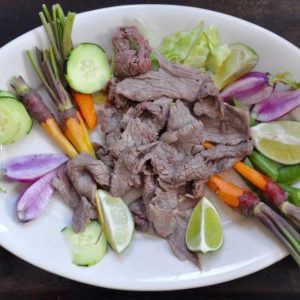
Shopping list: port coffee scallions sugar green tea okra garlic limes tomatillos black beans from bulk bin lemongrass!!! A few days ago I found myself staring at my shopping list, bemused. Okra? Tomatillos? Port? Lemongrass? When did I become a person urgently in need of lemongrass? Not so long ago…
Cauliflower with tomato and onion/Cauliflower Dum
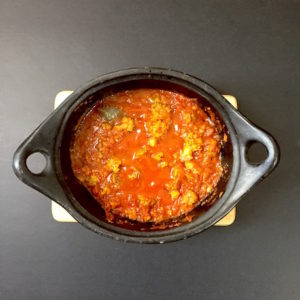
As I mentioned in an earlier post, I’m working with The Greatest Tomatoes Of Europe Campaign, who sent me more tomatoes last week. They also invited me to meet them at the San Francisco Fancy Food Show, which was held at the Moscone Center January 19-22. I’ll share a few…

