

Thai Salt-Pickled Cabbage (Pak Dong)
If you are feeling ever so slightly depressed these days, you might take heart at the notion of fermented cabbage as a unifying force.
Hear me out. At a time when people are busy insulting one another on social media and doing worse IRL, some of us have been equally busy fermenting cabbage. In fact, long before making sauerkraut became hip, people were salting down barrels of cabbage to carry them through the winter.
You know this, right? Or knew this. Given recent events, it’s easy to become distracted. Forgetful. Believe me, I know. Last week, while waiting to get on the freeway, I forgot why I was getting I-80 at all. This lasted only 30 seconds or so, but that 30 seconds was alarming.
Back to cabbage.
Almost every nation has a preserved cabbage recipe, because everyone needs to eat their vegetables, especially their green veggies. And once upon a time, our ancestors–whether they lived in Transylvania or Thailand–could not depend on year-round supplies of fresh green vegetables, much less the markets that sold them. So they preserved cabbage in salt.
Now, you may be rolling your eyes and thinking, the last thing I need is another sauerkraut recipe.
You’re right. This isn’t one.

—
Pak Dong, or Thai salt-pickled cabbage, comes to us from Pepper Tiegen’s Pepper Thai Cookbook. The crucial difference between her fermented cabbage recipe and the zillions of others you’ve read is her pickling medium. While my Eastern European ancestors relied on the liquid exuded from cabbage to ferment their sauerkraut, Tiegen’s were using the starchy water created by rinsing raw rice.

Tiegen swears this method works with “whatever vegetables you want to pickle,” and I am inclined to believe her.

For example….
Some of you may be wondering about the difference between pickling and fermenting. Technically speaking, pickling relies on vinegar and salt. Fermenting relies on salt; any liquid involved comes from the vegetables or fruits being fermented.

Of course there is all sorts of overlap, and people use the terms loosely. Today’s recipe is a good example: strictly speaking, Thai salt-pickled cabbage is a ferment. Then again, it relies on added liquid. But that liquid is not vinegar.

A person can go nuts trying to define these things, or just know that Thai salt-pickled cabbage is easy to make, requires no fancy equipment, and unlike many sauerkrauts, is a quick ferment: I made mine on a Sunday and was eating it by Thursday.
Into the kitchen.
Thai salt-pickled cabbage is ridiculously simple to make. Pretty much every ingredient is optional, save the cabbage, salt, and rice water. If you want to add a few more ingredients, Tiegen includes garlic, scallions, and a hot pepper. As my scallions were lesser specimens, I used a shallot instead.A few Cincinnati Red radishes were included for their sharp flavor and gorgeous color. Garlic, because I love garlic.

And of course I included a hot pepper, because when do I ever pass up an opportunity to include hot pepper?

Either Basmati or sweet glutinous rice may be used to achieve your starchy water. Do not even show the cabbage anything instant, boxed, or boil-in-a-bag.

Kosher or canning salt may be used to make salt-pickled cabbage. Do not use regular table salt, as it contains anti-caking chemicals that are ruinous to ferments.

Once the cabbage is chopped (see recipe, below) it is crucial that you rub salt into it on a tray rather than in a bowl or the canning jar. Why? Once you start massaging the cabbage with salt, it will begin giving off liquid–desirable when making sauerkraut. But here we are looking to ferment using rice water, meaning we want to leave as much liquid as possible behind once the cabbage goes into the jar.

Don’t do this.
Don’t drive yourself mad over this. But don’t do what I did, either: heap the cabbage into a bowl, crush it with a pestle, add it to the jar, and mash even more, a process that left me with jarful of cabbage liquid, wondering where I’d gone wrong.

Oops.
And no, this didn’t happen the last time I made it, because I followed Tiegen’s instructions. This time around, I poured the cabbage liquid off and added the rice water. All was well.

Once you have your nice jar of salt-pickled cabbage, set it someplace where it can find itself for a few days. Cover it loosely. If you screw down the lid tightly during fermentation, woe betide you: the jar may explode. This will not be a happy experience.

Depending on the temperature, Thai salt-pickled cabbage needs 3-5 days fermentation time. Taste it and see; it should be nicely sour. Screw the lid down and refrigerate.
Thai salt-pickled cabbage goes with almost everything: it’s wonderful in a ham sandwich, with rice, stir-fries, alongside chicken, pork, or fish. It lasts forever, but you won’t have it that long.

Thai Salt-Pickled Cabbage
With minor changes from Pepper Tiegen’s Pepper Thai Cookbook
Yield: one gallon/liter jar
Prep time: about 15-20 minutes vegetable prep, then 3-5 days fermentation time
You will need a 1 gallon/liter screw top glass canning jar or comparable vessel to make this recipe.
Please read the notes, below, before starting.
1 cup/227 grams Basmati or sweet glutinous rice
4 cups/1 liter water
1 small green cabbage, a scant 1 pound/500 grams
2 teaspoons Kosher or canning salt
optional additions:
10-12 garlic cloves
1 fresh hot red pepper
1 bunch scallions or 1 shallot
4-6 radishes, any type, well washed and trimmed
Sterilize the jar and lid.
Place the rice and water in a bowl or large measuring cup. Allow it to sit 10-15 minutes. Strain the rice, making sure you save the rice water. The wet rice may be stored in the refrigerator up to three days. Prepare it as you would normally.
Core the cabbage and chop into small pieces. You don’t need to shred it. Just make the pieces small enough to easily fit in the jar. Spread the cabbage out on a large baking tray.
Prep any additional vegetables you are including: smash and peel garlic cloves, trim and chop scallions, peel and chop shallots. If you are including radishes, peel if necessary and chop.
Using the side of a chef’s knife or other heavy object, pound the added vegetables lightly, so they break down. Add these to the cabbage tray.
If you are using a hot pepper, deseeding it will make it less spicy. Or you can include it whole. Drop in the glass jar.
Returning to the cabbage: Scatter the salt evenly over the vegetables. It may seem there is not enough. Don’t worry; there is.
With very clean hands, begin massaging the vegetables vigorously until they begin to break down, releasing their moisture. This will happen quickly. After a few moments, taste a piece of cabbage for salt. It should taste salty, but not overpoweringly so. If the cabbage is extremely bland–unlikely–carefully add a tiny bit more salt.
Begin loading vegetables into your jar. A funnel is helpful but not necessary. Compact the cabbage with a pestle or other heavy object (not a knife handle!). adding handfuls as you go. Liquid will well up; that’s okay.
Once the jar is full you may need to pour off quite a bit of cabbage liquid to make room for the rice water. I did. This depends on your cabbage. Pour off liquid if necessary and add the rice water. You want it to cover the cabbage completely.
Cover the jar loosely. If you screw the lid down now, you risk the gases from fermentation blowing the lid off and sending cabbage everywhere.
Fermentation takes 3-5 days. Check it daily, making sure the liquid is topped up and nothing is amiss. If it smells or looks bad, toss it. When in doubt, throw it out.
Taste on day three: it should be more sour than salty. Decide if you want to give it more fermentation time or refrigerate it. You may want to give it another two days.
When the cabbage is ready, screw down the lid and refrigerate it. Thai salt-pickled cabbage lasts indefinitely in the refrigerator, but will be gone long before that.
Notes:
Do not use table salt in this recipe. The anti-caking agents in table salt may keep it from clumping, but they also kill the desirable microbes necessary for fermentation.
On that note, let us discuss water.
Before writing the following, I consulted with an expert. This expert happens to be my husband, a civil engineer specializing in wastewater remediation. In addition to a Master’s Degree, my husband has a special certification called a Professional Engineering Licensure.
I think we can take his advice seriously.
I can’t tell you how often I read cookbooks suggesting water may be dechlorinated by placing it on a counter overnight. This, we are told, allows the chlorine gases to disperse.
In plain English, this is utter bullshit.
Should your water taste and smell of chlorine, my husband suggests purchasing an inexpensive water filter. Unlike buying countless bottles of filtered water, a water filter will rapidly pay for itself.
I would add that many people inhabit areas where the tap water is just fine. They may be experiencing other civic issues–indeed, some of them horrific–but the tap water? Just dandy.
My point? If your water is heavily chlorinated, yes, it will cause problems with your pickle. But if it isn’t, don’t go looking for trouble. We all have enough going on as it is.
Lecture concluded.

Share:
You might also like:
Cabbage Soup
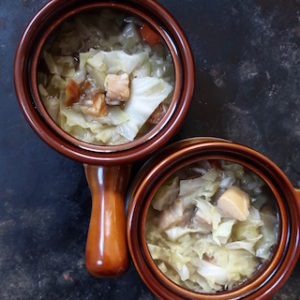
Pity the poor cabbage. It gets a bad rap. Too many people are scarred by bad cabbage experiences: boiled beyond recognition….or the cabbage soup diet. Lacking illustrative photos of overboiled cabbage or the soup diet, I give you San Francisco’s Union Square. More accurately, a street near Union Square. Handled…
Dried Shrimp and Pickled Lettuce Salad
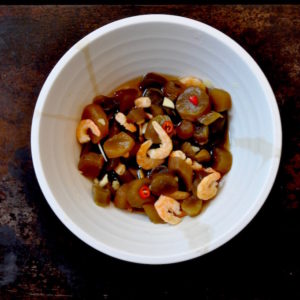
Occasionally you pick up a cookbook at random. You park it on your “to read” shelf with every intention of getting around to it. Meanwhile, various disasters transpire: dental work, feline illness, neighbor drama, spousal sickness, inept national leadership, world mayhem. Finally you open the cookbook. There, glimmering, is the…
Back-in-the-Pot-Pork

My community college photography classmates would have decimated the shot below. After slowly feeding my ego through the wood-chipper for using color film, a choice signaling rank amateurism, the group would have settled in for a nice long discourse about compositional elements. Meaning ninety minutes on the blue rubber band. Fortunately, none…

