

Creamed Kohlrabi
Perhaps, like me, you’ve been kohlrabi-avoidant. Or maybe life hasn’t brought you into contact with the vegetable Yotam Ottolenghi compared to an alien. He’s right: kohlrabi is a strange looking vegetable.

Don’t let this deter you. After almost sixty years of kohlrabi avoidance, I recently discovered what I was missing, and happily share my conversion with you. I owe my discovery to Luisa Weiss, whose Classic German Cooking includes a recipe for creamed kohlrabi. My recipe isn’t quite hers, but without her book, I might have spent the remainder of my life sans kohlrabi.

Before entering the kitchen, a brief kohlrabi biography. A member of the brassica family, kohlrabi is commonly found in green and purple varieties.The peel is tough and must be removed, revealing an interior that may be eaten raw or cooked. The leaves are also edible. Cooked, kohlrabi is texturally reminiscent of water chestnut, with a gently bland flavor that allows it to partner with all manner of dishes. I have no idea why it’s not more popular in the United States. It should be.

Into the kitchen.
We all have cookbooks that warn against dull knives. Better to own three truly sharp knives than a batterie of dull ones, these books tell us, going on to say the worst kitchen accidents occur with dull blades. Friends, creamed kohlrabi exemplifies these warnings. Not that I cut myself; I didn’t. But my knives are sharp, and yours should be, too. Kohlrabi does not go gently into the that good night.

I found kohlrabi peeling easier going around the vegetable rather than sweeping top to bottom.
Peeling dispensed with, the kohlrabi must be cut into batons. Weiss suggests 1/4 inch/6mm batons. I did not measure mine, but they’re not that small. Or especially elegant. Whatever you do, make sure your kohlrabi batons are roughly the same size, ensuring even cooking.

If your kohlrabi has healthy leaves attached, Weiss suggests folding a few into the final dish. Most of the leaves in my bunch were good only for compost. The remainders were refrigerated for another night.
Weiss cooks her kohlrabi in vegetable broth. Having none, I used chicken. The kohlrabi is simmered in whatever broth you have until tender–about ten minutes–then strained.

Don’t toss the cooking liquid. You’ll need it shortly.
At this point you make a bechamel. Melt butter in a saucepan.

Scatter flour over butter.

Whisk. Watch butter and flour clump alarmingly in whisk’s wires. Panic. Remember this happens every time you make bechamel. Grab favorite wooden spoon. Prise floury mess out of whisk. Fling whisk in sink. Add small amount of kohlrabi cooking liquid to pan, just enough to loosen things up. Stir madly. Watch floury mess smooth out into a sauce. Slowly add remainder of cooking liquid. Stir some more. Add dairy.

Taste for seasoning. Add kohlrabi to saucepan. Taste for seasoning again. Serve.
And there you are. Alien vegetable, on the table.

Weiss suggests serving creamed kohlrabi with plain boiled potatoes, a fine idea. What she doesn’t mention is creamed kohlrabi improves with time. Leftovers are even good cold, something I’d never expect of creamed anything.
Creamed Kohlrabi
Adapted from Luisa Weiss’s Classic German Cooking
Serves 2-4 as a side dish
Prep/cooking time: about 30 minutes
Please see notes, below, for discussion of ingredients and recipe variations.
You will need a medium bowl, a strainer, a medium lidded saucepan, and a vegetable peeler or sharp paring knife to make creamed kohlrabi.
3-4 green or purple kohrabi, with or without leaves
2 cups/500 ml unsalted chicken or vegetable broth
2 tablespoons sweet butter
3 tablespoons AP flour
2 cups/500 ml dairy (see notes)
salt and pepper to taste
Wash the kohlrabi to free it of any grit. If your kohlrabi has leaves and they’re in good condition, you can set a few aside to include later. Otherwise, trim kohlrabi so you’re left with the circular portions.
Peel the kohlrabi, then slice into roughly 1/2 inch/1.5cm batons. You don’t need to measure precisely, but take care to cut the batons into similar sizes so they cook evenly.
Put the batons into the saucepan. Pour the broth over. The broth may seem to barely cover the vegetables. That’s okay.
Bring the broth to a gentle boil, then turn down to a medium simmer. Cover the pot and cook until kohlrabi are easily pierced with a fork, 10-15 minutes.
Put the strainer in a bowl. Strain kohlrabi, saving the cooking liquid.
Make the bechamel:
I use the same pan I cooked the kohlrabi in.
Over low heat, melt the butter in the pan.
Scatter the flour over the butter. Using a whisk or a wooden spoon, whatever you prefer, whisk or stir until flour and butter blend. If flour clumps into a mess, turn the heat down and trickle in a little of the kohlrabi cooking liquid. Whisk or stir, and the sauce will smooth out. You are looking to cook the flour so the final sauce has no floury bits.
Gradually add the kohlrabi cooking liquid, stirring until you have a thin sauce. Add the dairy and stir until blended–this will happen quickly.
Taste for salt and pepper.
Add the kohlrabi, stir, and taste again for seasoning.
Fold in leaves, if using, and serve.
Weiss notes creamed kohlrabi is delicious with plain boiled potatoes, and she’s right. We’ve eaten it with roast chicken, alone for lunch, and cold from the fridge. It keeps well, refrigerated in a covered container. Do not freeze.
Notes:
Weiss uses 3/4 cup/200ml whole milk in her recipe. I preferred less dairy, and used half-and-half, which is half whole milk and half whole cream, because it’s what I have in the house.
The kohlrabi were delicious cooked in broth, and I would definitely prepare the dish up to this point and serve it as is.
The original recipe includes nutmeg. I omitted it because I’m not fond, but feel free to add it back in.
Creamed kohlrabi is easily made vegan: replace the chicken broth with vegetable broth. Prepare the bechamel using a vegan spread and your preferred nut milk.
Weiss notes the flour may be replaced with a gluten-free product, making this dish safe for celiac sufferers.

Share:
You might also like:
Olive-Oil braised Celery with Potatoes and Carrots
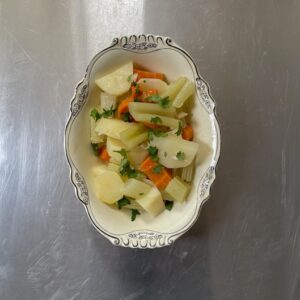
With the holidays approaching, it is never the bird, the cranberries, or even the stuffing (roast in the bird or out?) that gives me pause. It’s not the sides, or whether or not to prepare brussels sprouts, which invariably go uneaten. Friends, it’s the celery. (We’re just talking food….
Mandelhornchen (chocolate-dipped almond crecscents)
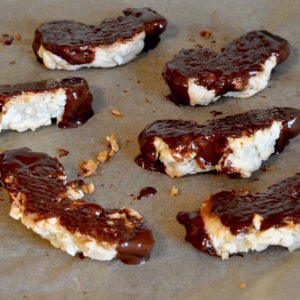
Apologies for the silence around here. The IK hasn’t been idle. If anything, she’s been cooking far too much food as NPR blares in the background. Just a few days ago, she bought far too much fruit. Before it could rot, she baked it into a cake adapted from a…
Apple Marzipan Cake

Apple marzipan cake came about because as everyone else began cooing over farmers market fraises de boise and posting nauseating recipes for rhubarb bowls (go ahead, tell me you haven’t seen some gross stuff out there), I faced a fridge brimming with apples. In the hunt for something interesting to…

